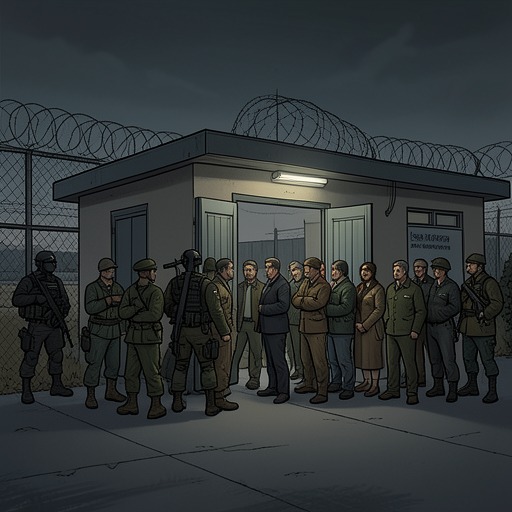
Lookout Tower
The Dog StarsThe Lookout Tower is the defensive structure Hig and Bangley build on the plain beyond Erie Airport, a substitute for the control tower the airfield never had. Its elevated sightlines and reinforced porch make it more than an observation post: it gives Bangley a position from which to watch the approaches and support Hig under attack. Built from salvaged materials and fitted out for deliberate use, the tower embodies the pair’s effort to turn a vulnerable airport into a defended perimeter.
Purpose and Setting
Erie Airport is an uncontrolled field, where pilots communicate with one another and rely on established protocol rather than a control tower. Hig and Bangley create a different kind of tower four miles out on the plain, partway toward the mountain front. Its purpose is not to direct aircraft but to watch and defend the ground around their home. The structure occupies a strategic distance from the airport: close enough to oversee the open approach, yet set out on the plain rather than among the hangars.
That defensive purpose responds to the airport’s attractions as a survival site. It has water, fuel, and infrastructure for sustainable power: the houses have solar panels, while the fixed-base operator relies largely on wind. Those resources make the airport useful, but also draw intruders. Hig has already begun sleeping outside because of attacks; armed visitors arrive alone or in groups, often at night, drawn toward the light on the porch. The tower is part of a broader effort to survive the consequences of having something worth taking.
Construction and Equipment
The tower takes two months to build. Hig and Bangley salvage lumber by carefully dismantling a blocky wooden building on Piper Lane, then haul it to the site in a pickup and Bangley’s dry-van trailer. The trailer has carried weapons, mines, canned food, and ammunition, but the construction project also depends on less conspicuous equipment: they bring out a generator from an unpowered hangar and run it on aviation fuel to power the saws and drills. The structure is therefore made from reclaimed materials, but its construction still requires transport, fuel, tools, and coordinated labor.
Bangley’s investment in the tower is particularly visible in its shooting platform. He designs a bench rest and locking swivel for the upper level, along with mounts for a spotting scope and a laser rangefinder. The gun and optical equipment are not left there, but the fixed fittings are ready for them. A windspeed-and-direction indicator remains on its own pole, positioned so that the roof does not distort the readings with diverted or eddying air. Hig makes a carefully joined drawer for Bangley’s ballistic tables. The appointments make the tower a prepared working position, even when its most specialized equipment is elsewhere.
The height is also a matter of practical disagreement. Hig recalls wanting a twenty-foot tower, while Bangley insisted on thirty, a dispute that kept Hig irritated for two weeks. During the later attack, Bangley points back to that decision and to the porch’s reinforced, double-joisted construction: the height gives him a view of the attackers, and the sturdy porch serves a purpose beyond standing room. The argument over dimensions thus becomes a reminder that Bangley’s plans were made for a danger Hig had not fully anticipated.
A Watched Approach
The tower’s position shapes the ground beyond it. Bangley prefers a range of fourteen hundred yards, and the trail Hig and Jasper have worn toward the mountains crosses a point at roughly that distance from the tower. The path is familiar to them after years of use, but its openness also makes it exposed to Bangley’s view. The landscape that functions as Hig’s route away from the airport is, from the tower, a field of observation and potential danger.
This arrangement gives the tower a double meaning within their daily routine. It is part of the airport’s defense, but its reach extends into the space Hig uses for solitude and travel. The trail belongs to Hig and Jasper through repeated passage; the tower belongs to Bangley’s system of surveillance and calculated distance. The two uses meet on the plain, where a familiar route can also become a watched approach.
The Tower Under Attack
The tower’s value becomes explicit when nine attackers approach Hig. From his position, Bangley tells Hig to hold his ground and describes what he can see: the attackers have gone to ground, but he expects to spot them if they move or attempt to flank. He uses a rock to orient Hig’s attention and offers to call out direction and distance, turning the attack into a coordinated exchange between the man on the ground and the observer above. The height that Bangley had argued for now supplies a clear view of the threat and makes communication possible.
The tower’s porch also conceals a further layer of defense. Bangley reveals that he has hidden a British 81 mm mortar near the structure and uses it to aid Hig. He later explains that, when he first saw the nine approaching, he went down to retrieve the weapon from its hiding place because Hig might need help. The mortar’s presence surprises Hig; its concealment means that the tower’s defensive capacity is not fully apparent even to the person who helped build it. Bangley had kept the weapon in reserve for a crisis, and the reinforced porch is part of the preparation that allows the position to serve its purpose.
Significance
The Lookout Tower converts the open plain into a designed defensive space. Its construction depends on salvage and ordinary labor, while its fittings reflect Bangley’s exacting attention to sightlines, wind, range, and stability. At the same time, it is not a self-sufficient machine: the weapons are not permanently left on the platform, the mortar must be retrieved, and the tower’s usefulness depends on Bangley’s judgment and his ability to communicate with Hig.
Its most consequential feature is the contrast between what it appears to be and what it can do. A tower at an uncontrolled airport might ordinarily serve aviation, but this one has no role in directing aircraft; it exists to watch the perimeter and support armed defense. Even its porch, an apparently simple part of the structure, has been reinforced with a future emergency in mind. The tower stands as a practical expression of the alliance between Hig and Bangley: one man moves through the landscape, while the other watches from above, and their survival depends on connecting those different positions.